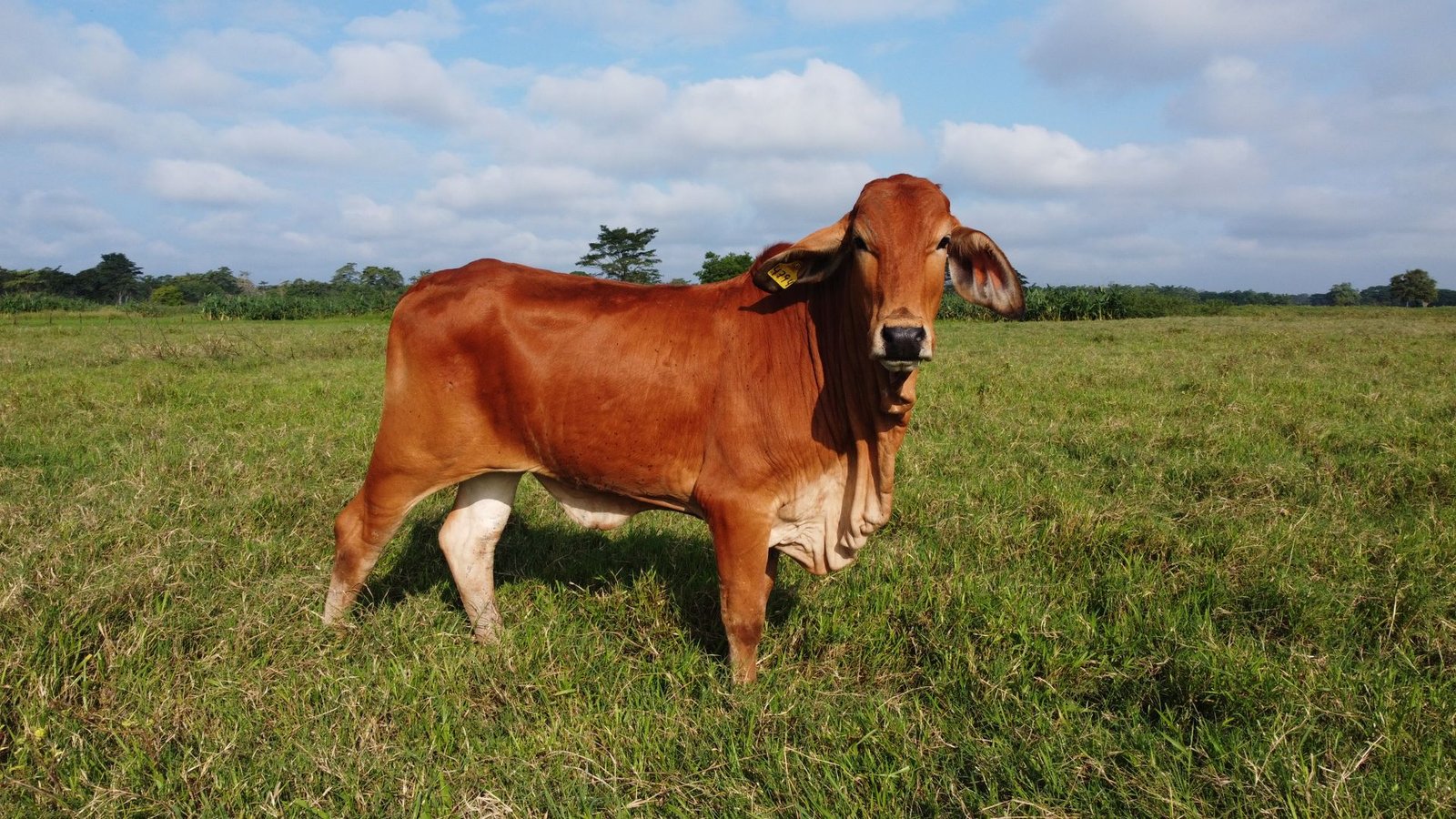
Brahman cattle are built for heat. The hump, the loose skin, the big drooping ears and the short, glossy coat are not just for show; they are the reasons a Brahman cow can keep grazing, calving and raising a good calf in the Lowveld, the bushveld and the hot north-west, where many European breeds battle. More than seventy years after the first animals arrived from Texas, the Brahman is one of the most important beef breeds in South Africa, both on its own and in the crossbred calves that fill the country’s feedlots.
This guide covers everything you need to know about Brahman cattle in South Africa: where the breed came from, the red and grey types, size and growth, why they cope so well with heat and ticks, fertility and mothering, their role in crossbreeding, what they cost at auction in 2026, and what to check before you buy.
Brahman Cattle at a Glance
| Trait | Brahman |
|---|---|
| Type | Bos indicus (zebu) beef breed, developed in the United States |
| In South Africa since | 1954 |
| Colours | Red and grey (often called white) |
| Mature bull weight | About 700 to 1,000 kg |
| Mature cow weight | About 450 to 650 kg |
| Birth weight | About 25 to 35 kg |
| Main strengths | Heat tolerance, tick resistance, longevity, mothering and crossbreeding value |
Weights come from published breed profiles and vary between herds. Expect bigger animals on good grazing and smaller ones on poor veld.
1. Where Brahman Cattle Come From
The Brahman was developed in the southern United States in the early 1900s from several Indian zebu breeds, and the name was adopted when the American Brahman Breeders Association was formed in 1924. Ranchers in Texas and along the Gulf Coast wanted cattle that could survive heat, humidity and insects that wore down British breeds.
The breed reached southern Africa in 1954. According to the Brahman Cattle Breeders’ Society of South Africa, a farmer from Windhoek imported 8 bulls and 10 heifers from Texas ranches that year, landing them in Cape Town. Other importers followed, and the breed spread quickly: between 1960 and 1970, the number of registered births rose more than tenfold.
Today the Brahman is one of the largest registered beef breeds in the country. In January 2026, Farmer’s Weekly described it as the third-largest registered breed in South Africa, with more than 56,000 registered animals and about 360 active breeders.
2. Red and Grey Brahman Cattle
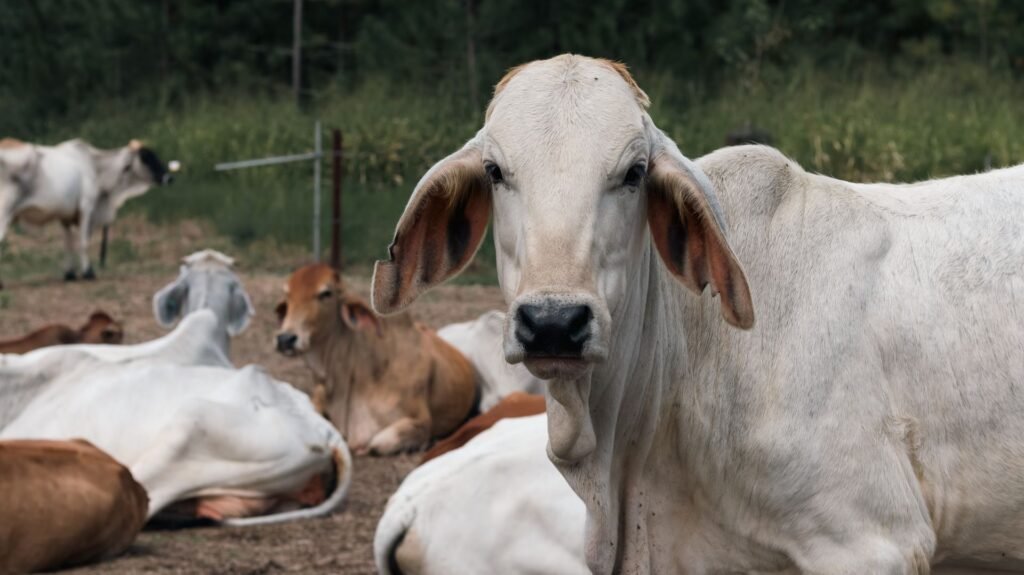
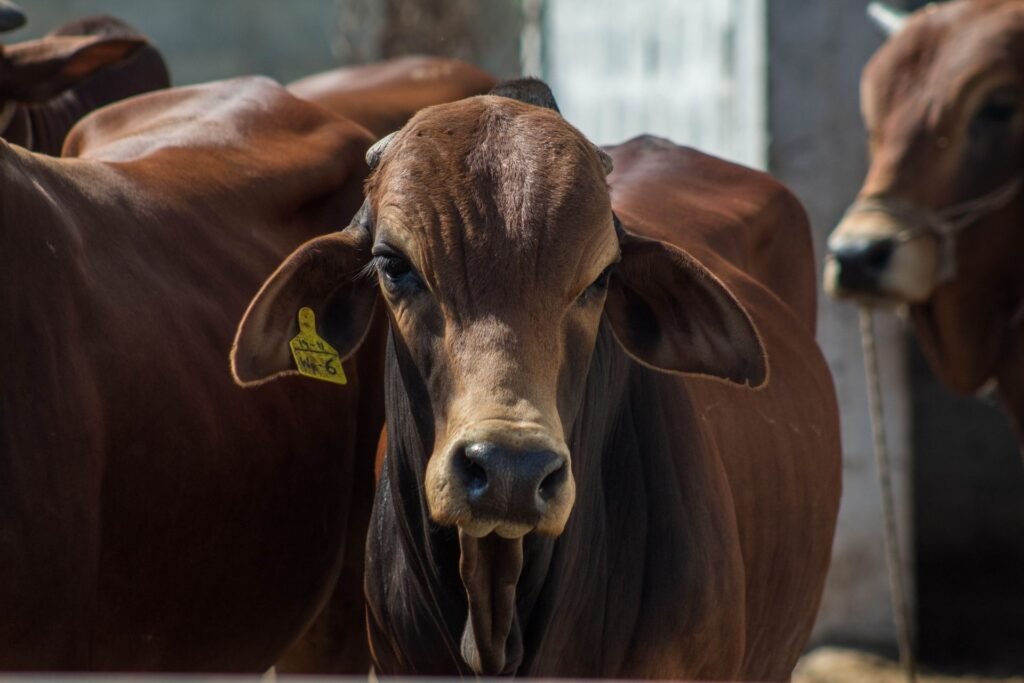
South African breeders recognise two colour types: red Brahmans and grey Brahmans, which are often called white. Both share the same breed standard and the same zebu features: a prominent hump over the shoulders, long, drooping ears, loose skin with a large dewlap and folds along the throat, and a short, smooth coat over dark, pigmented skin.
The choice between red and grey is mostly personal preference and what local buyers like. Price differences between the types tend to be small: at the Kroon Vee auction near Vryburg in May 2026, the stud’s red animals and its Manso-line animals sold at very similar averages.
3. Size and Growth
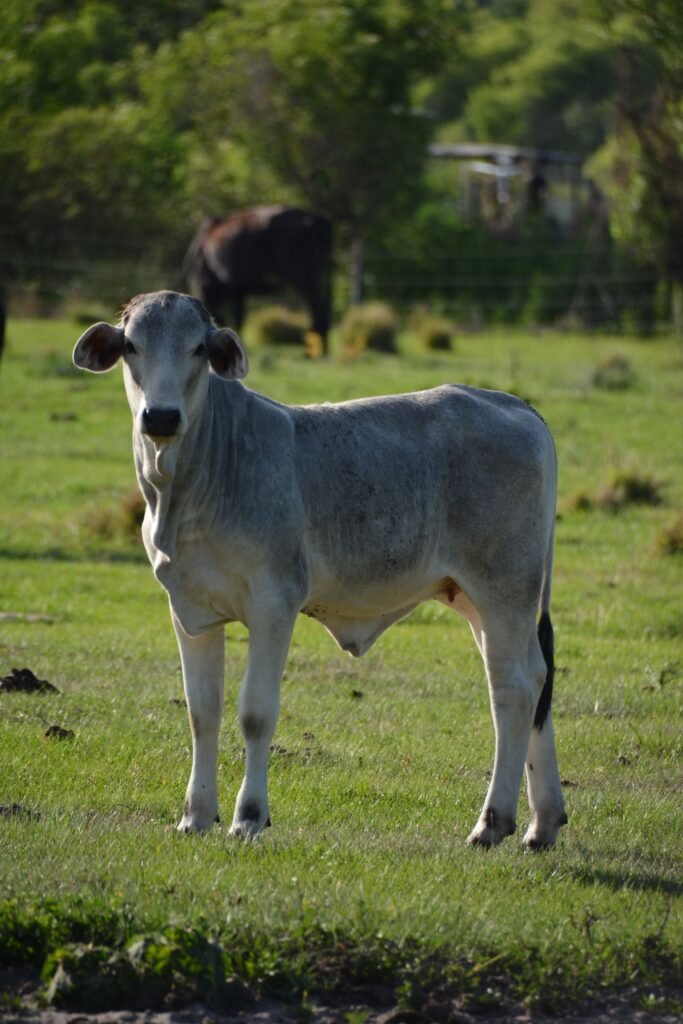
The Brahman is a large, long-legged breed. Breed profiles put mature bulls at about 700 to 1,000 kg and cows at about 450 to 650 kg, with calves born at around 25 to 35 kg. The relatively small calf for the size of the cow, together with a sloping rump, helps make calving easier.
Brahman cattle tend to mature later than many British breeds. Farmer’s Weekly notes that this gives them a longer marketing window: young Brahman cattle can still qualify for the A and AB age classes for as long as 32 months, so farmers do not have to rush them off the veld to keep the best price.
4. Why Brahmans Handle Heat and Ticks So Well
The Brahman’s adaptation to hot conditions comes from its zebu ancestry. Breed profiles describe several features that work together:
- Short, glossy hair and dark skin that reflect sunlight and protect against sunburn.
- More sweat glands than most European breeds, so they can cool themselves more easily.
- Loose skin, a large dewlap and big ears, which increase the body surface area for losing heat.
- An oily skin secretion that helps repel ticks and flies, while the short, smooth coat gives parasites less to hold on to.
In practice, this means Brahman cattle keep grazing through the heat of the day when other cattle look for shade, and they usually need less dipping. They are not immune to ticks or tick-borne diseases, so you still need a tick control and vaccination plan, but the workload and cost are usually lower than with European breeds in the same area. For signs and prevention of the main health risks, see our guide to cattle diseases in South Africa.
5. Fertility, Mothering and Longevity
Brahman cows are known as excellent mothers. Farmer’s Weekly describes them as very protective of their calves, which is a big advantage where jackals, caracals and other predators are a problem, though it also means you should handle cows with young calves carefully.
The breed is also long-lived. Farmer’s Weekly says Brahman cows can stay productive for 15 to 18 years, and some breed profiles say up to 20, which spreads the cost of buying or raising each cow over many more calves.
Pure Brahman heifers can reach puberty later than British breeds, especially on poor veld, so good heifer nutrition matters if you want them to calve at a young age. Many breeders also select specifically for fertility, using the breed society’s performance-recording and genomic tools to identify the most fertile bloodlines.
6. Brahmans in Crossbreeding
The Brahman’s biggest influence on the South African beef industry may be through crossbreeding. Crossing Brahman cattle with British or European breeds produces strong hybrid vigour, and the crossbred calves combine heat tolerance with faster growth and better carcass quality. For a British breed often used on Brahman-type cows, see our guide to Angus cattle.
The Brahman has been used to create many composite breeds, including the Brangus, Braford, Simbra, Beefmaster, Santa Gertrudis, Sabre and Charbray. According to Farmer’s Weekly, more than 60% of animals in South African feedlots are Brahman or Brahman-type cattle, which shows how widely Brahman genetics are used in commercial herds.
A common approach is to run Brahman or Brahman-cross cows and use a British or European bull, such as an Angus or Simmentaler, to produce fast-growing weaners for the feedlot. Our comparison of Angus vs Simmentaler looks at two popular choices for that role.
7. Brahman Cattle Prices in 2026
Brahman breeding stock has sold well in 2026, with stud bulls in strong demand. Two recent auctions give a good picture:
- Kroon Vee Brahman auction, near Vryburg, 23 May 2026: Manso bulls averaged R78,000 and red bulls R71,666, with a top bull at R140,000. Stud heifers averaged about R37,200 to R37,800, and commercial females R22,700 (red) to R24,900 (Manso), according to African Farming.
- ONE WIL DON auction, Thabazimbi, 20 August 2026: 44 white stud bulls averaged R58,068, with a top price of R170,000. Pregnant commercial cows averaged R30,769, pregnant heifers R27,913, cows with calves R28,568 and heifers R20,458, as reported by African Farming.
For commercial farmers, these sales suggest roughly R20,000 to R31,000 for good commercial heifers and cows, and R55,000 to R80,000 for an average stud bull, with top bulls costing much more. Prices change from sale to sale, so treat these as reference points.
8. The Market for Brahman Calves
Brahman and Brahman-cross weaners are sold into the same weaner market as other beef calves, and feedlots buy them in large numbers. Pure Brahman calves are often lighter at weaning than calves from larger European breeds, while Brahman-cross calves usually grow faster and sell well. Our guide to weaner prices in South Africa explains how calves are priced and what they are worth in 2026.
Pros and Cons of Brahman Cattle
| Advantages | Things to consider |
|---|---|
| Excellent heat and drought tolerance | Heifers can reach puberty later on poor veld |
| Good resistance to ticks and flies | Cows are very protective of calves and need careful handling |
| Long productive life | Pure Brahman weaners can be lighter than European-cross calves |
| Easy calving and strong mothering | Less suited to very cold, high-altitude areas without good management |
| Outstanding crossbreeding value and strong feedlot demand | Stud bulls are expensive |
Is the Brahman Right for Your Farm?
Brahman cattle are a strong choice if you farm in hot, humid or tick-heavy areas such as Limpopo, Mpumalanga, KwaZulu-Natal, North West and the Lowveld, or if you want hardy cows to cross with a British or European bull. They also suit farmers who want long-lived, low-maintenance cows on extensive veld.
If you farm in cold, high-lying areas with good grazing, a European or composite breed may suit you better. Our comparison of Brahman vs Bonsmara sets the two breeds side by side, and our guide to cattle farming in South Africa covers grazing, health and management.
What to Check Before You Buy Brahman Cattle
- Temperament: watch how the animals handle in the pens. Calm, manageable cattle are safer and easier to work.
- Fertility records: ask for calving dates, pregnancy test results and, for bulls, a breeding soundness examination.
- Breed features: look for good muscling, sound legs and feet, a well-attached sheath or navel, and correct breed type.
- Performance data: for stud animals, ask for registration papers and performance or genomic breeding values.
- Health and movement documents: make sure animals are vaccinated and can be moved legally, especially in areas affected by foot-and-mouth disease restrictions.
- Paperwork: buy from a registered business, get a written quote and pay only against an official invoice.
Our guide to buying livestock in South Africa covers each step in more detail.
Frequently Asked Questions
When did Brahman cattle come to South Africa?
The first Brahman cattle arrived in 1954, when 8 bulls and 10 heifers were imported from Texas and landed in Cape Town. The breed spread quickly and is now one of the largest registered beef breeds in the country.
How big do Brahman cattle get?
Breed profiles put mature Brahman bulls at about 700 to 1,000 kg and cows at about 450 to 650 kg, with calves born at around 25 to 35 kg.
Why are Brahman cattle good in hot areas?
They have short, glossy coats, dark skin, more sweat glands than European breeds and loose skin with large ears, all of which help them stay cool. An oily skin secretion also helps repel ticks and flies.
What is the difference between red and grey Brahman cattle?
Mainly colour. Both types share the same breed standard and traits, and price differences between them at auction are usually small.
How much do Brahman cattle cost in South Africa?
At 2026 auctions, commercial Brahman heifers and cows sold for roughly R20,000 to R31,000, and stud bulls averaged about R58,000 to R78,000, with top bulls fetching R140,000 to R170,000.
Are Brahman cattle good for crossbreeding?
Yes. Brahman crosses show strong hybrid vigour, and the breed has been used to create composites such as the Brangus, Braford, Simbra and Beefmaster. Farmer’s Weekly reports that more than 60% of feedlot cattle in South Africa are Brahman or Brahman-type.
Where can I buy Brahman cattle in South Africa?
You can buy at Brahman auctions, from registered breeders or from established suppliers. DRM Livestock supplies Brahman cattle across South Africa with delivery arranged.
Final Thoughts
Brahman cattle earned their place in South Africa by doing well where other breeds struggle: in heat, among ticks and on long, dry seasons. Whether you run them pure or use them as the foundation of a crossbreeding herd, they give you long-lived, protective cows and calves that feedlots want. If you are ready to build or improve your herd, have a look at our Brahman cattle for sale, or send us your requirements and we will get back to you with a written quote, including delivery to your farm.
Looking to buy cattle?
Tell us the breed, age group, quantity and delivery area. We reply with availability, pricing and transport costs, usually within one working day.
DRM LIVE STOCK is a registered South African livestock company (Company No. K2023207798, VAT No. 4640323079) based at 135 Rocklands Rd, Uitenhage Farms, Gqeberha. We supply cattle, goats, sheep and pigs, with delivery across South Africa.