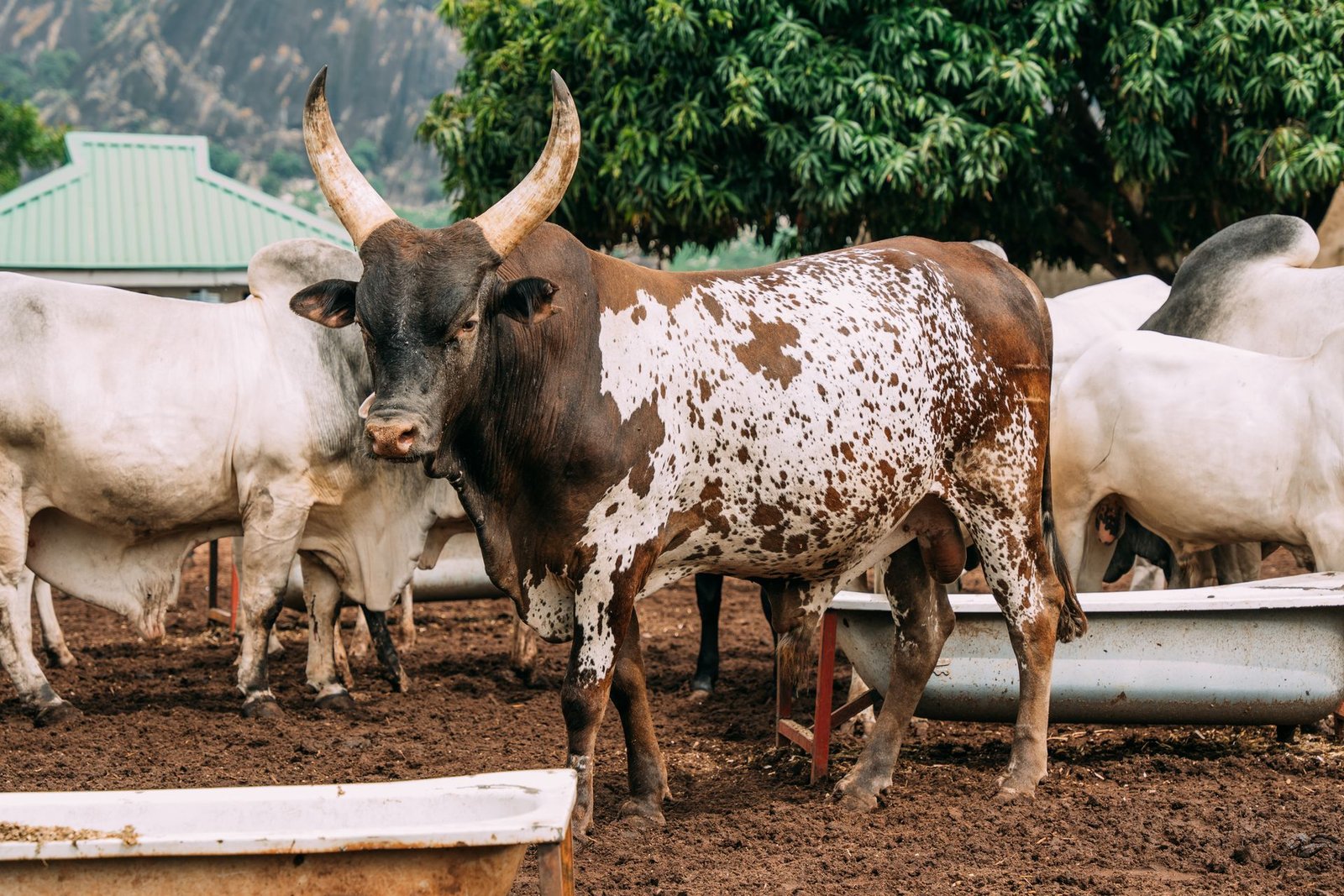
Bonsmara vs Nguni is one of the most common arguments you will hear at any cattle auction in South Africa, and both sides usually have a point. The Bonsmara is the country’s great commercial beef breed, built on performance records to wean heavy calves. The Nguni is the indigenous survivor, a smaller cow that keeps calving year after year on veld where other breeds struggle.
Neither breed is “better” in general. Each is better on a particular farm, in a particular market, run by a particular farmer. This guide sets out the seven differences that matter most when you are choosing between them, with real figures from breed research and recent auctions, so you can decide which one fits your veld, your management and the buyers you sell to.
Bonsmara vs Nguni at a Glance
| Bonsmara | Nguni | |
|---|---|---|
| Origin | Developed in South Africa at the Mara and Messina research farms | Indigenous Sanga-type cattle of southern Africa |
| Make-up | 5/8 Afrikaner, 3/16 Hereford, 3/16 Shorthorn | Pure indigenous breed |
| Colour | Red | Many colours and patterns |
| Mature cow weight | About 500 to 550 kg | About 320 to 440 kg |
| Mature bull weight | Around 900 kg | About 500 to 700 kg |
| Main strength | Growth, weaning weight and a carcass the feedlots want | Fertility, calving ease, tick resistance and low inputs |
| Best suited to | Commercial weaner production on reasonable veld | Harsh, tick-heavy or low-input systems |
The weights above come from breed profiles published by ProAgri for the Bonsmara and Oklahoma State University’s breeds database for the Nguni. Individual herds vary, but the size gap between the two breeds is real and it drives almost every other difference.
1. Where the Two Breeds Come From
The Bonsmara was bred on purpose. Before and after the Second World War, the Department of Agriculture crossed British beef bulls on Afrikaner cows at its Mara and Messina research farms, looking for cattle that combined British growth and meat with Afrikaner hardiness. The name joins “Bonsma”, after Professor Jan Bonsma who led the work, and “Mara”, the farm. The final formula settled at 5/8 Afrikaner, 3/16 Hereford and 3/16 Shorthorn, and animals were selected on measured performance from the start. That focus on records is still at the heart of the breed today. Our full guide to Bonsmara cattle in South Africa covers the breed in more detail.
The Nguni was not designed by anyone. It is a Sanga type that came into southern Africa with the people who herded it, and it was shaped over centuries by drought, ticks, disease and the veld itself. Nguni cattle have long been central to Zulu culture, and the Nguni Cattle Breeders’ Society describes the breed as built for production under harsh African conditions. Natural selection did the culling long before farmers did.
That history explains the rest of this comparison. The Bonsmara was selected for output. The Nguni was selected for survival.
2. Size, Growth and Weaning Weight
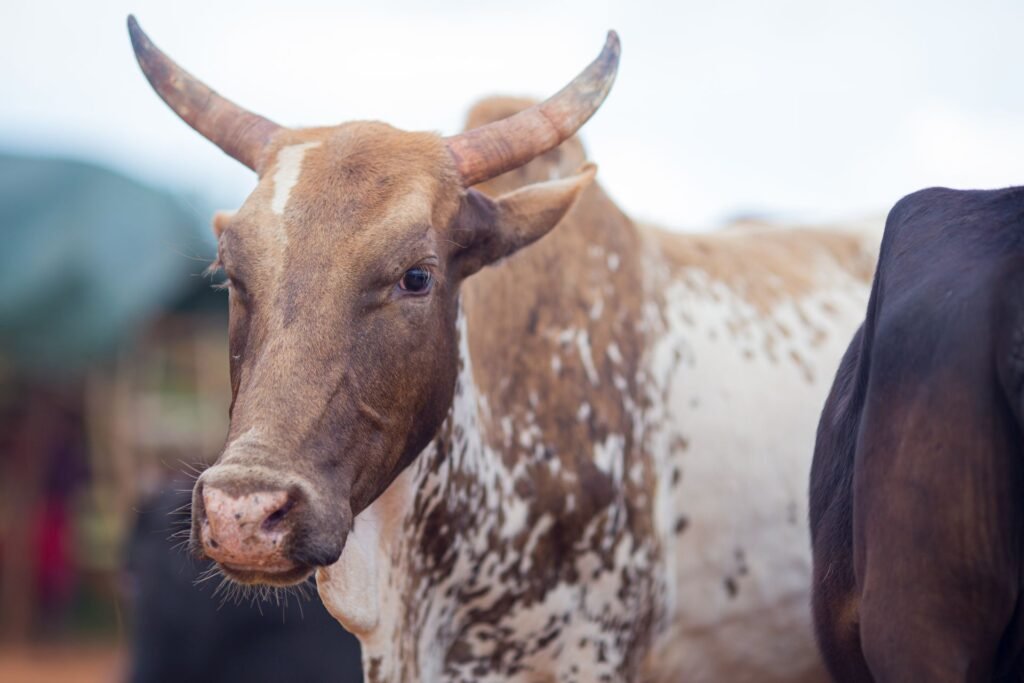
This is the Bonsmara’s home ground. A Bonsmara cow is roughly 100 to 200 kg heavier than an Nguni cow, and her calves grow accordingly. Heavy, even weaners are exactly what feedlots pay for, and that is why the Bonsmara is so widely used in commercial weaner production.
The Nguni answers with efficiency rather than size. At the Dohne Agricultural Development Institute’s Nguni stud near Stutterheim, cows weighing 320 to 360 kg weaned calves with an average 205-day weight of 153.5 kg, and produced 39.5 kg of calf for every 100 kg of cow mated over 18 years, according to Farmer’s Weekly.
So the honest way to compare them is not per calf but per hectare. A smaller cow eats less, so you can usually run more Nguni cows than Bonsmara cows on the same veld. Whether more lighter calves beat fewer heavier calves depends on your carrying capacity and on what your buyers pay per kilogram for each type of weaner.
3. Bonsmara vs Nguni Fertility and Calving Ease
Both breeds are fertile when they are well managed, but the Nguni has a reputation that is hard to beat, especially under tough conditions.
On a Limpopo farm near Mooketsi that has run Nguni for about 40 years, the herd averages 371 days between calvings with a calving rate of about 95%, and it is not unusual to have 18-year-old cows still in production, as reported by Farmer’s Weekly in September 2026. The farmer, a vet himself, said he rarely needs to treat his cattle and could remember only a handful of difficult calvings in four decades.
Low birth weights and the Nguni’s build make calving problems uncommon, which matters a great deal on big extensive farms where cows calve out in the veld without anyone watching. Long productive lives also mean fewer replacement heifers every year.
The Bonsmara is also known as a good, easy-care mother with enough milk to wean a strong calf. On a farm with good veld and sound management, a Bonsmara herd will calve well. The difference shows up when conditions are hard: drought, poor veld, heavy tick loads or limited supervision. That is where the Nguni tends to keep its calving rate while bigger breeds slip.
4. Hardiness, Ticks and Disease
The Nguni is famous for its resistance to ticks and tick-borne diseases. Its thick, pigmented skin, short coat and centuries of natural selection mean it carries fewer ticks and copes better with the diseases they spread. In practice, that means less dipping, fewer losses and lower costs, particularly in the Lowveld, KwaZulu-Natal and the Eastern Cape.
The Bonsmara is no softie. Its Afrikaner blood gives it good heat tolerance and resistance to many of the tick-borne diseases that trouble purely European breeds, and it is farmed successfully from very dry to very wet regions. But in the heaviest tick areas and the harshest low-input systems, most farmers would agree the Nguni has the edge.
5. Veld, Feed and Management
The Bonsmara performs best when it is fed to its potential. On sweetveld or well-managed mixed veld, with a sensible lick programme through winter, it turns grass into heavy weaners efficiently. Push it onto poor veld with no supplementation and its advantage in growth starts to shrink. Our feeding cattle guide explains how to plan a lick programme for each season.
The Nguni is a thrifty animal that holds condition on the veld alone and walks well over rough, broken country. It suits farmers who want a low-input system, farms with sourveld or steep terrain, and communal or emerging farmers who cannot afford high feed and veterinary costs. It is also easy to handle and generally calm, although, like any breed, temperament depends on how the cattle are raised and worked.
6. The Market for Weaners and Beef
Here the Bonsmara has a clear commercial advantage. Feedlots know Bonsmara weaners, and heavy, uniform red calves are easy to sell at auction. If your plan is to sell weaners to the feedlot market, the Bonsmara fits that market very well.
Nguni weaners are lighter, and some buyers discount them. A Limpopo farmer interviewed by African Farming in 2026 chose Nguni cows for their hardiness and disease resistance on mountain veld, but found that her cattle did not always fetch the prices she expected at auction, and now crosses her Nguni cows with larger bulls to add weight.
The Nguni has other markets, though. Nguni beef is lean and well regarded, and the breed’s patterned hides are in demand, which the Nguni society highlights. Ngunis also sell well into the stud, emerging-farmer and cultural markets, where hardiness and colour are valued as much as weight.
7. Bonsmara vs Nguni Prices: What Breeding Stock Costs
Recent auction reports give a useful picture of breeding stock prices.
Bonsmara. At the Towton Bonsmara production auction in Kuruman on 15 April 2026, 17 bulls averaged R61,188, commercial cows with calves averaged R22,819 and pregnant commercial heifers R21,556, according to African Farming. At the Theres Bonsmara auction near Klerksdorp on 14 May 2026, 23 stud bulls averaged R62,478, cows with calves R22,387, pregnant heifers R17,250 and open heifers R13,875.
Nguni. At the 29th Central Nguni Club auction near Bloemfontein in October 2023, 13 bulls averaged R79,077 and the top bull sold for a possible world record of R570,000, while pregnant heifers averaged R13,196, pregnant cows R13,071 and cow-and-calf units R15,532, as reported by African Farming.
| Category | Bonsmara (2026 auctions) | Nguni (2023 club auction) |
|---|---|---|
| Bulls | R61,188 to R62,478 average | R79,077 average |
| Cows with calves | R22,387 to R22,819 average | R15,532 average |
| Pregnant heifers | R17,250 to R21,556 average | R13,196 average |
The Nguni figures are older, so allow for price movement since then, and remember that these are stud and production sales. Still, the pattern is typical: Nguni females usually cost less per head than Bonsmara females, which lowers the cost of building a herd, while top Nguni bulls can be just as expensive as Bonsmara bulls. For a full breakdown, see our guide to Bonsmara cattle prices. For more on what shapes cattle prices, see our guide to cattle farming in South Africa. For Nguni auction results and weaner values in more detail, read our guide to Nguni cattle prices.
How the Two Breeds Handle a Dry Winter
If you want to see the real difference between these breeds, watch them through a long, dry winter on the same farm. That is when the Bonsmara vs Nguni debate stops being theory.
A big-framed cow needs more feed simply to maintain her body, and in late winter, when the grass has lost most of its protein, she relies heavily on the lick you put out. Bonsmara cows on a good winter lick programme hold up well and go on to wean heavy calves. Cut the lick or overstock the veld and they lose condition, which can delay their return to heat after calving and stretch the calving interval.
Nguni cows usually come through the same winter in better condition on less. They are smaller, they walk further to find feed and they are good at selecting what little nutrition the veld still offers. Many Nguni farmers still feed a winter lick, but the breed forgives mistakes and dry years more readily.
The lesson is simple. If you can manage your veld and feed well, the Bonsmara will pay you back for it. If you cannot always control those things, because of drought, distance, cost or limited labour, the Nguni gives you a safety margin that is hard to put a price on.
Why Not Both? Crossing Bonsmara and Nguni Cattle
Many commercial farmers end up using both breeds. A common approach is to keep Nguni cows for their fertility, hardiness and low maintenance, and mate them to a larger bull, such as a Bonsmara, to produce heavier crossbred weaners that the feedlots like. The crossbred calf gets hybrid vigour and extra growth, while the cow herd keeps the Nguni’s low running costs.
The catch is managing replacements. If you keep crossbred heifers as future cows, your herd slowly drifts away from the small, hardy Nguni type. Some farmers solve this by breeding their own Nguni replacements from part of the herd, and others buy in Nguni heifers. Plan this before you start, not after the first crossbred calves arrive.
Calving ease also needs attention. Choose a bull known for moderate birth weights when mating a larger breed to small Nguni heifers.
Bonsmara vs Nguni: Which Should You Choose?
Here is how I would decide, based on the farm rather than the breed.
Choose the Bonsmara if:
- You sell weaners to feedlots and are paid on weight.
- Your veld is reasonable and you can run a proper lick and health programme.
- You want a breed with strong performance records, easy to buy and easy to sell.
- You are building or supplying a commercial herd where uniform red calves matter.
Choose the Nguni if:
- Your farm has heavy tick loads, sourveld, rough terrain or limited water.
- You want low input costs, easy calving and cows that last many years.
- You are starting out with limited capital and want an affordable, forgiving breed.
- You sell into markets that value hardiness, colour, hides or stud Nguni genetics.
Choose both if:
- You want the hardiness of Nguni cows and the weight of crossbred weaners, and you are prepared to plan your replacement heifers.
Whichever you choose, the individual animal matters more than the breed name. A fertile, well-adapted cow from a well-managed herd will outperform a poor one of any breed.
What to Check When Buying Bonsmara or Nguni Cattle
- Fertility records: ask about calving intervals and whether cows calve every year.
- Adaptation: cattle bred in a similar climate and tick environment to yours will settle faster.
- Legs, feet and teeth: sound feet and a good mouth mean a longer working life.
- Bulls: insist on a recent breeding soundness examination by a vet.
- Health status: ask about vaccinations and the herd’s disease history, including brucellosis testing for females.
- Paperwork: registration certificates for stud animals, identification for every animal and any veterinary movement permits needed under the current foot-and-mouth disease controls.
The Bonsmara breeders’ society and the Nguni Cattle Breeders’ Society can put you in touch with registered breeders and upcoming auctions.
Buying Bonsmara and Nguni Cattle from DRM Livestock
We supply both breeds to farmers across South Africa, including weaners, heifers, pregnant cows, cows with calves and breeding bulls, with transport arranged to your farm. Every animal comes with identification documents, and we work with the state vet on any movement permits.
See what we offer on our Bonsmara cattle for sale and Nguni cattle for sale pages, or request a quote with the number and type of cattle you need and your location. If you are still weighing up other breeds, compare the Brahman, which is also well suited to hot, tick-heavy areas. If you are also considering a zebu breed, read our comparison of Brahman vs Bonsmara.
Frequently Asked Questions About Bonsmara vs Nguni
Which is more profitable, Bonsmara or Nguni?
It depends on the farm. The Bonsmara usually earns more per calf because its weaners are heavier, while the Nguni often costs less to run and allows more cows per hectare. On good veld selling to feedlots, the Bonsmara often wins. On harsh, tick-heavy or low-input farms, the Nguni can be more profitable.
Is the Nguni better than the Bonsmara for beginners?
For many new farmers, yes. Nguni cattle are hardy, calve easily, resist ticks and cost less to buy and keep. A beginner with good veld and a feedlot market nearby may still prefer the Bonsmara.
How much heavier is a Bonsmara than an Nguni?
Published breed profiles put mature Bonsmara cows at about 500 to 550 kg and Nguni cows at about 320 to 440 kg, so a Bonsmara cow is roughly 100 to 200 kg heavier.
Can you cross Bonsmara and Nguni cattle?
Yes. Mating Nguni cows to a Bonsmara bull is a popular way to produce heavier weaners while keeping a hardy, low-cost cow herd. Plan how you will breed or buy your replacement heifers.
Are Nguni cattle really tick resistant?
Nguni cattle are well known for their resistance to ticks and tick-borne diseases. They still need a sensible tick control and vaccination programme, but usually far less intervention than European breeds.
Do Nguni weaners sell for less at auction?
Often, per animal, because they are lighter. Some buyers also discount them per kilogram. Nguni farmers who sell weaners to feedlots often use a larger crossbreeding bull to add weight.
Final Thoughts
The Bonsmara vs Nguni question has no single right answer. The Bonsmara gives you weight, growth and an easy sale to the feedlots. The Nguni gives you fertility, hardiness and low costs where the veld and the ticks are tough. Look honestly at your farm, your management and your market, and the right choice usually becomes clear. If you would like help sourcing either breed, send us your requirements and we will get back to you with a written quote.
Looking to buy cattle?
Tell us the breed, age group, quantity and delivery area. We reply with availability, pricing and transport costs, usually within one working day.
DRM LIVE STOCK is a registered South African livestock company (Company No. K2023207798, VAT No. 4640323079) based at 135 Rocklands Rd, Uitenhage Farms, Gqeberha. We supply cattle, goats, sheep and pigs, with delivery across South Africa.