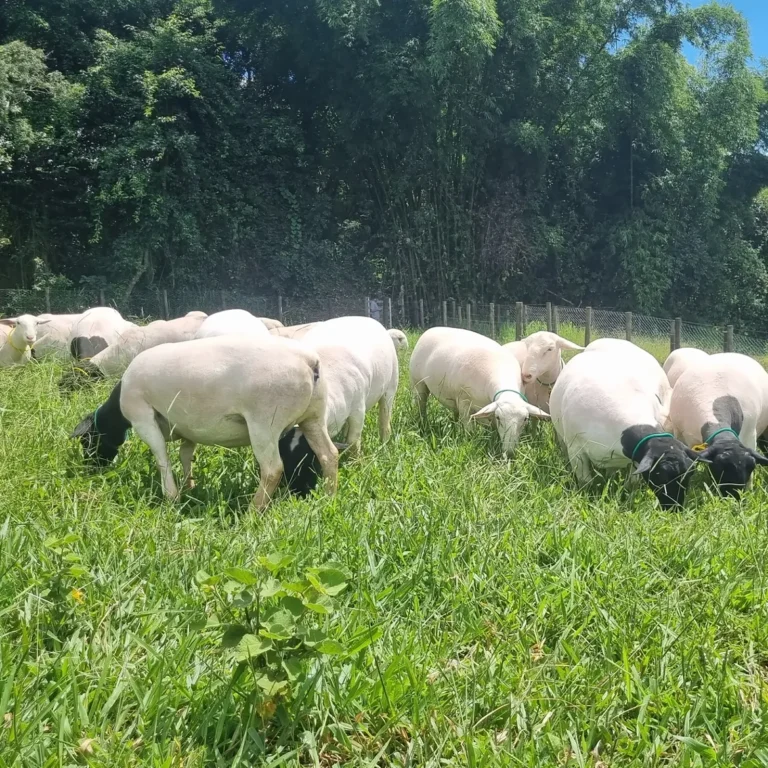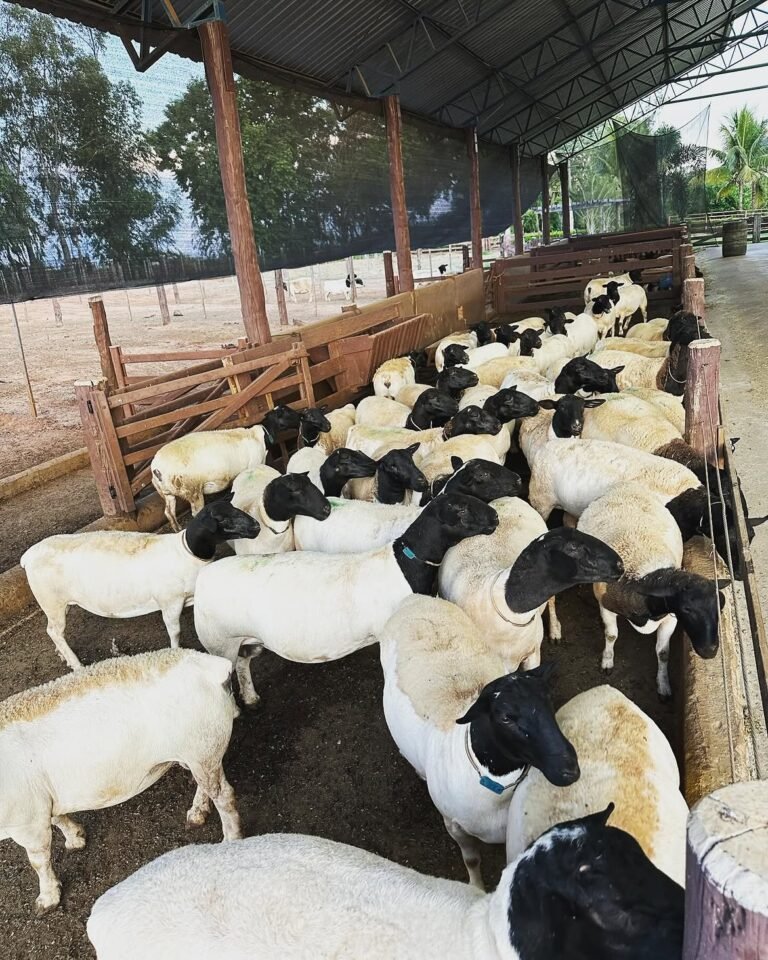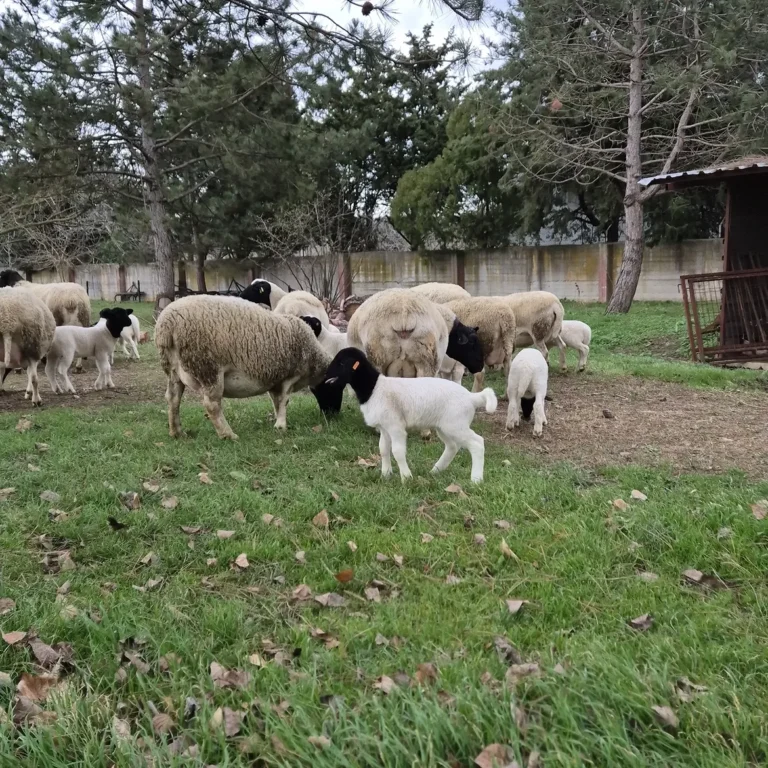
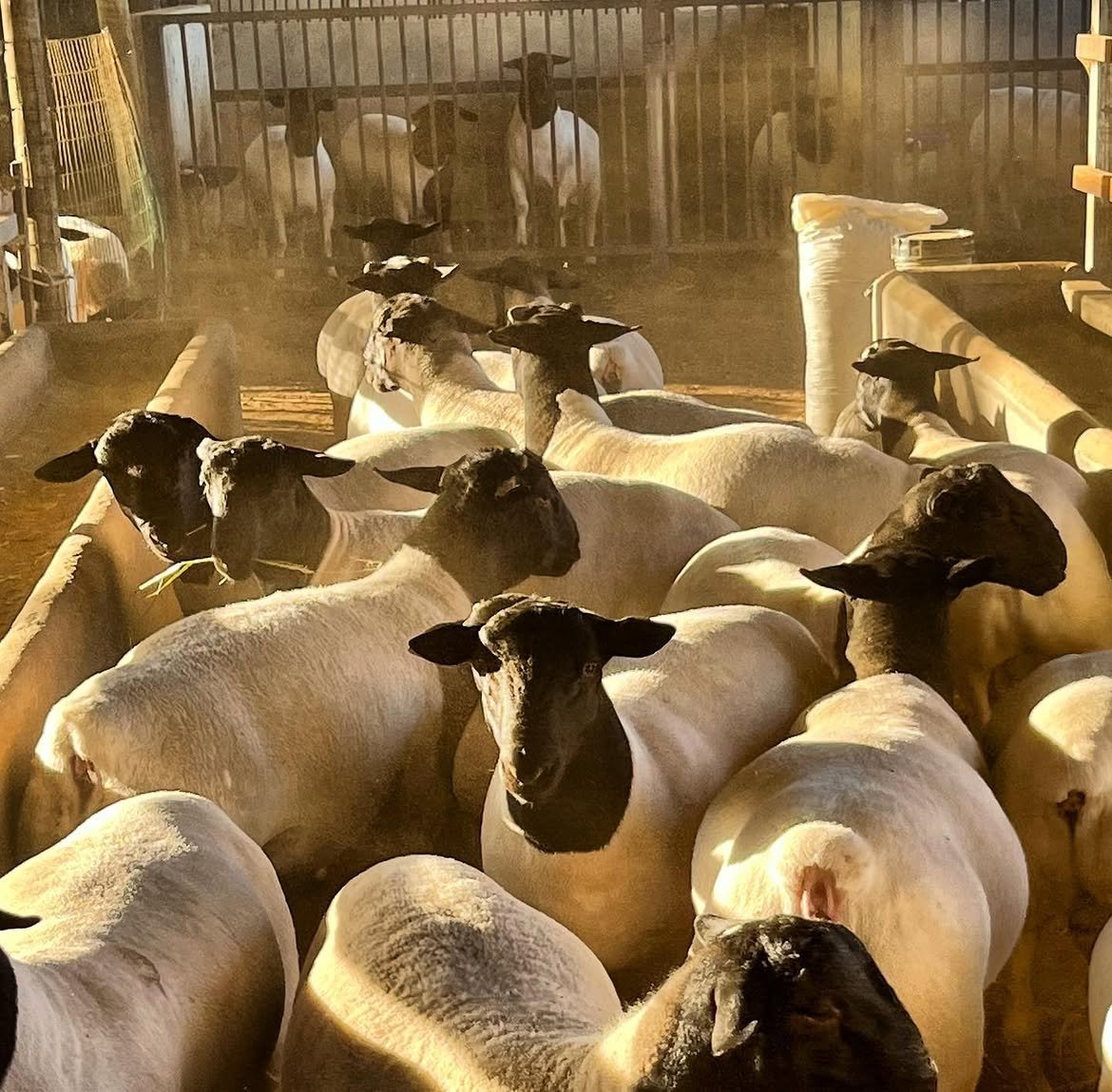
Every Dorper flock is the sum of the decisions made at the sorting race. Which ewe lambs stay, which old ewes go on the truck, which ram you bring home from the sale. Get those right year after year and the flock improves almost on its own. Get them wrong and no amount of feed will fix it.
The trouble is that the wrong sheep often look like the right ones. A big, deep, heavily muscled ram stands out in any sale pen. A ewe in show condition catches the eye. But the ewe that pays for herself is the one that takes the ram, lambs without help, rears her lambs and does it again next season on ordinary veld. You cannot always see that from the side of the pen.
This Dorper sheep breeding guide covers how to choose ewes and rams, which replacements to keep, the records that make selection easier, and the mistakes that quietly hold a flock back.
Dorper Sheep Breeding: What Makes a Good Breeding Animal?
The Dorper was bred in South Africa to produce meat lambs in hard, dry conditions. That is still the test. A good breeding animal is one that stays sound, stays fertile and rears useful lambs on the veld you actually have, not on the feed you wish you had.
In practice that means balancing a few things at once: fertility, mothering ability, growth, structural soundness, carcass and adaptation to your conditions. Push hard on one of them and you often lose another. A very fast-growing line with poor fertility is not an improvement. Neither is a fertile ewe whose lambs never grow.
The Dorper Sheep Breeders’ Society of South Africa sets the breed standard and runs inspections for registered animals. It is worth reading, especially if you plan to buy or breed stud sheep. For a commercial farmer, the breed standard matters most where it overlaps with function: sound feet, a correct mouth, a good udder and a well-built, meaty body.
Decide What Your Flock Is For
Before you look at a single sheep, be clear about what the flock has to produce. Selection for a commercial slaughter-lamb operation is not the same as selection for a stud that sells rams to other farmers.
- Commercial lamb production: fertility, lamb survival, mothering ability and growth to weaning come first. Registration is optional.
- Breeding your own replacements: add longevity and the performance of the ewe families you are keeping daughters from.
- Stud breeding: pedigree, breed standard, inspection results and measured performance all matter, because your buyers will ask about them.
- Crossbreeding: a Dorper ram on other ewes is often used to improve the growth and carcass of slaughter lambs. Here the ram’s growth and carcass traits carry more weight.
Neither approach is better than the other. They are different jobs, and the animals you select should suit the job.
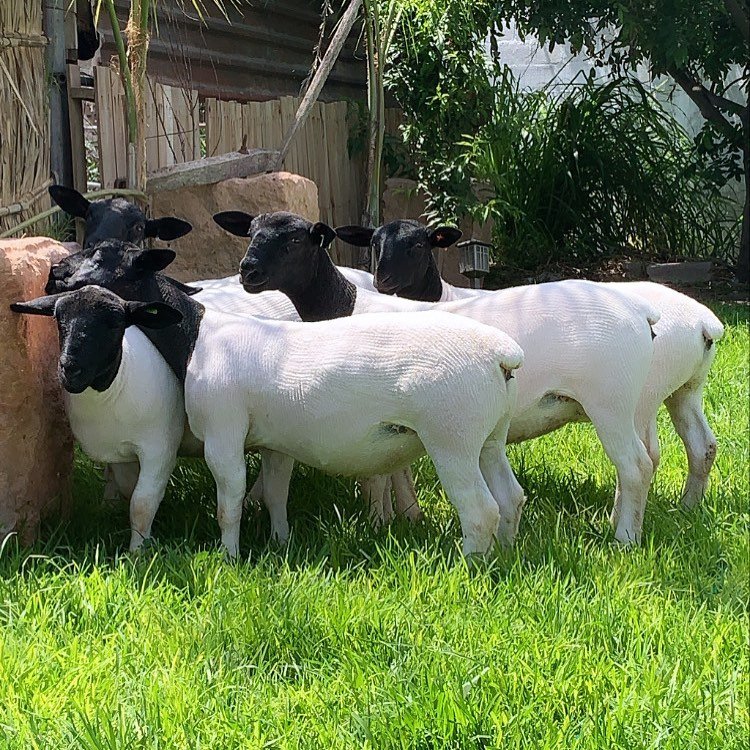
How to Choose Dorper Ewes
People spend a lot of time talking about rams, and with reason: one ram sires a big share of your lamb crop. But the ewe flock is the engine. Every season each ewe has to conceive, carry, lamb, milk, rear, and recover in time to do it again. A ewe that manages that for six or seven seasons is worth a great deal. One that looks good but misses every second year is costing you money every time you feed her.
Look at her mother first
When you choose young ewes, the most useful information is usually not on the ewe herself but on her dam. Did the mother conceive every season? Did she rear twins without help? Did her lambs wean well? A replacement from a productive ewe is not guaranteed to be good, but she starts with better odds than a replacement from a ewe that needed help every lambing.
Open the mouth
The teeth should meet the dental pad squarely. An undershot or overshot jaw is a fault that can be passed on, and it affects how well she grazes on short veld. On older ewes, check for worn or missing teeth. A broken-mouthed ewe has little working life left, whatever her record.
Feel the udder
Run your hands over the whole udder. You want two functional teats, correctly placed, and soft udder tissue without hard lumps. A ewe with a blind half or a lumpy udder from old mastitis cannot rear twins properly. On a buying trip, this is the check that most often separates a good-looking ewe from a useful one.
Watch her walk
A ewe on veld walks to water and grazing every day. Look for sound feet, strong pasterns, straight legs and an easy, even stride. Lameness, overgrown or misshapen hooves and weak pasterns get worse with age and on hard ground, and some of it is heritable.
Do not choose ewes on size alone
A bigger ewe needs more feed just to maintain herself. On good pasture that may not matter. On dry veld, the oversized ewe is often the first to lose condition, and the first to miss at mating. The right size is the size your veld can carry in a normal year, not the size that impresses at the sale.
Check condition with your hands
Dorpers carry a mix of hair and wool that hides a lot. Feel along the backbone and over the loin and ribs. Most farmers score condition on a 1 to 5 scale and aim for ewes around 3 at mating: backbone felt but not sharp, with a good cover of muscle and some fat. Thin ewes cycle poorly and have fewer twins. Very fat ewes can have their own fertility and lambing problems.
How to Choose a Dorper Ram
A ram used for a few seasons can sire hundreds of lambs, and his daughters will stay in your flock for years after he is gone. That is why ram selection deserves more than a quick look and a bid.
Soundness before looks
A ram has to walk the camp, find ewes on heat and mount them many times over a mating season. Weak feet, sickle hocks or a weak back will let him down just when you need him. Always watch a ram move, not only stand. A thick neck and big hindquarters do not make up for poor legs.
Testicles
Both testicles should be present, firm, springy, roughly equal in size and free of lumps. Feel the tail of each epididymis at the bottom of the scrotum as well; swelling there can be a sign of infection. Scrotal size is linked to sperm production, so a ram with small or soft testicles is a poor risk however well he is built.
A breeding soundness examination
For any ram you are relying on, ask your vet to do a breeding soundness examination before the mating season. It usually covers a physical check, scrotal measurement and a semen test. The cost is small next to the cost of a failed season, where you only find out months later, at lambing, that half your ewes are empty.
Libido and condition
A fertile ram still has to want to work. Watch new rams with ewes if you can. Bring rams into mating fit but not fat: a fat ram tires quickly and may not cover the ewes, and a thin ram does not have the reserves to last the season. Start preparing them about two months before mating, because sperm takes several weeks to produce, and any illness or fever in that time can reduce fertility for weeks afterwards.
Ask the questions the sale pen does not answer
What did his dam produce? How did his half-brothers and sisters perform? Has he been inspected, and what grade did he get? Was he raised on veld or fed hard for the sale? A ram fed heavily for a sale can look spectacular and then drop condition quickly on your veld. None of that means he is a bad ram, but you need to know what you are paying for.
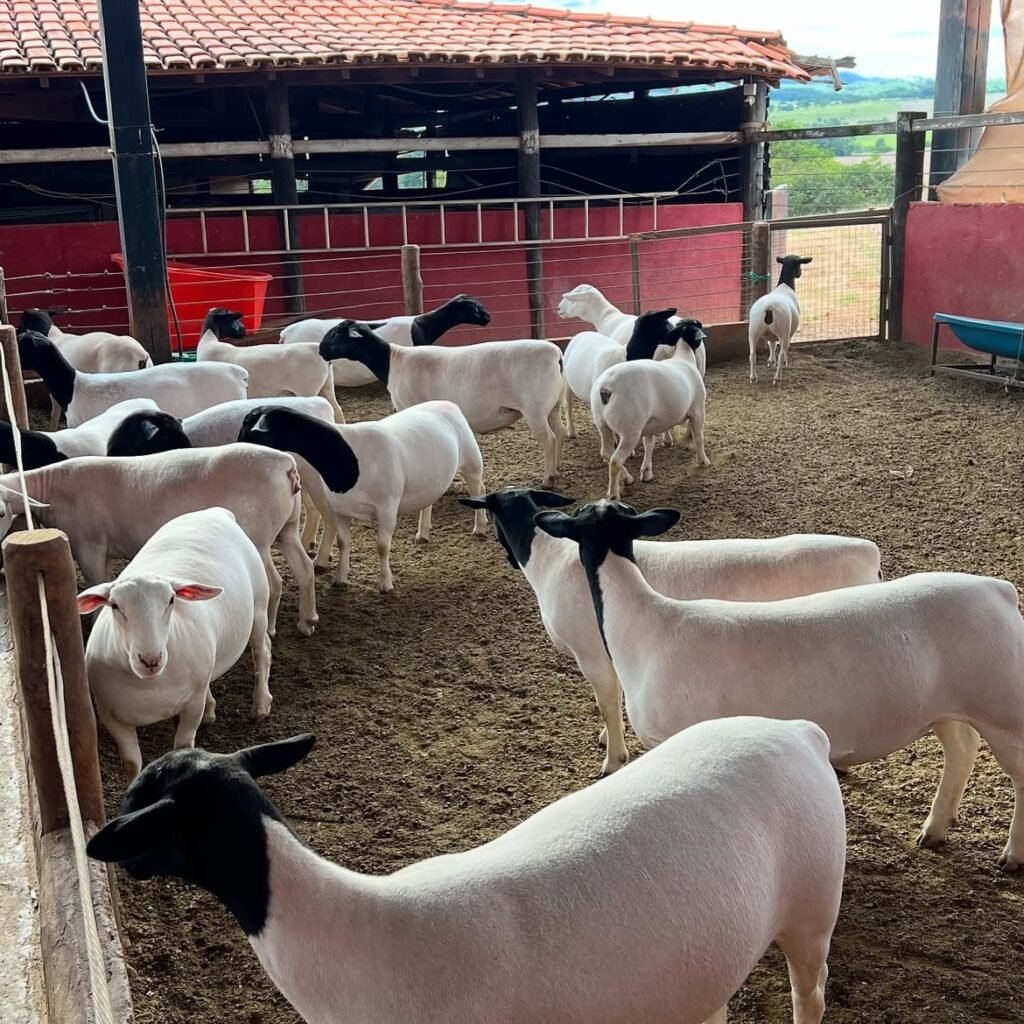
Choosing Replacement Ewes
Every ewe lamb you keep decides what your flock will look like in five years. Keeping every female lamb is not selection; it is just keeping sheep.
Good replacements usually come from ewes that conceived every season, reared twins or strong singles without help, and kept their condition. Among those daughters, keep the ones that grew well, are sound on their feet, have a correct mouth and look like Dorpers. Cull the rest to slaughter, even if it hurts to see good-looking lambs go.
The hardest moment is a season when you are short of ewes. The temptation is to keep the weaker lambs to make up numbers. That is how flocks slide backwards without anyone noticing. If your own replacements are not good enough, it is often better to buy in good young ewes than to lower your standard.
Records: Where Real Selection Starts
Almost every farmer believes he knows which of his ewes are the good ones. Put that belief next to the lambing records and you usually find a few surprises. Memory remembers the ewe that looks good and forgets the one that quietly missed.
You do not need software to start. A notebook, a spreadsheet or a phone app will do. For each ewe, record at least:
- her tag number and year of birth
- which ram she was mated to
- whether she lambed, and when
- number of lambs born and reared
- lamb weaning weights
- any assistance at lambing, treatments and health problems
- why she was culled, when she goes
After three seasons you can rank ewes on what they have actually produced. A common rule on commercial farms is that a ewe that is empty twice, or fails to rear her lambs twice, goes. Records make that decision easy and fair.
If you want to go further, the breed society’s performance testing scheme measures traits such as weaning weight and reproduction across flocks. That is mostly for stud breeders, but it shows why measured information beats a good eye alone.
Managing the Mating Season
Rams that run with the ewes all year give you lambs all year. That sounds productive, but it makes everything else harder: you cannot plan feed, dosing, vaccination or marketing around a lambing season that never ends, and you cannot easily tell which ewes are missing.
A controlled mating season fixes that. A ewe comes on heat roughly every 17 days, so a mating period of about six weeks gives each ewe two or more chances to conceive. Lambing then falls into a known window, you can check ewes are pregnant (scanning is worth it), and any ewe that does not conceive in that time is easy to spot.
Dorpers can breed through much of the year, and under good feeding some farmers run three lambings in two years. That system asks a lot of the ewe and the veld, and it only works with good nutrition and tight management. For most farmers, one well-managed mating a year, timed so that lambing falls when the veld is at its best, gives better results with less stress on the ewes.
Many farmers also flush their ewes, giving them better grazing or a supplement for a few weeks before and during mating. Ewes on a rising plane of nutrition tend to ovulate more eggs, which can mean more twins.
How Many Ewes Can One Dorper Ram Cover?
There is no single number that suits every farm. A mature, sound ram in good condition in a controlled mating season is commonly put with somewhere around 30 to 50 ewes. Young rams in their first season should get fewer. Big, bushy camps, rough terrain and short mating periods all mean you need more rams. When a lot rides on one ram, many farmers put two rams in together or rotate them, so that one poor ram does not cost them the season. Your vet can help you set a ratio for your conditions.
Avoid Chasing Extremes
More muscle is not always better. More size is not always better. Over the years the breed society itself has warned breeders about selecting too hard for size and extreme muscling at the cost of fertility and adaptability.
Every trait you push has a cost somewhere else. Very big frames need more feed. Very heavy muscling can go with lambing problems. Animals selected in feedlot conditions may not handle veld. Decide what your weak points are, fix them one at a time, and check that you are not creating a new problem while you do it.
Commercial Flock or Stud: Which Genetics Do You Need?
Most commercial farmers do not need stud ewes. What they need is fertile, sound, adapted commercial ewes and a genuinely good ram. Spending on the ram is where stud genetics pay off, because his influence reaches every lamb.
Stud breeders need to add pedigree, registration, inspection and measured performance to everything above, because that is what their buyers are paying for. But stud sheep that cannot function on veld are no use to anyone either.
Buying Dorper Breeding Stock
If you are starting a flock or bringing in new blood, buying well can save you years. Buying cheap usually costs you years.
Young or mature animals?
Young ewes and rams cost less and give you more breeding years, but you know less about how they will perform. Mature, proven animals come with a track record, which is worth paying for, but they have fewer seasons left. Many farmers buy young ewes and a proven ram.
What to ask the seller
- How old are the animals, and what do their mouths show?
- Have the ewes lambed? Are there lambing and weaning records?
- Are the animals registered or inspected? What grade?
- What were they raised on, veld or intensive feeding?
- What vaccinations and dosing have they had?
- Has the ram had a breeding soundness examination?
- Why are they being sold?
- Are transport, marks and movement documents arranged?
A good seller will answer all of these without fuss.
What breeding stock costs
Prices vary enormously between commercial animals, flock animals and top stud animals. As a reference point, at the 5-Star Dorper auction in Upington in March 2026 flock ewes averaged about R3,000, flock rams about R7,785 and stud rams about R10,500, with top-grade rams averaging R17,650. Individual top animals can sell for much more. Our guide to Dorper sheep prices in South Africa explains what moves the price. Whatever you pay, weigh it against what the animal will add to your flock, not against how it looked in the pen.
Quarantine and Health When Bringing In New Sheep
New sheep bring new germs, new worms and sometimes new problems such as footrot or sheep scab. Keep new arrivals in a separate camp for at least 28 days, check their feet, dose them with a remedy your vet recommends, and watch them before they join your flock. This protects both your flock and the money you just spent on genetics.
Animals must carry the seller’s registered mark and come with a document of identification. Where foot-and-mouth disease controls apply, cloven-hoofed animals also need an official veterinary movement permit. Rules change, so check with your local state vet before moving sheep.
Common Dorper Breeding Mistakes
- Keeping every ewe lamb. More females is not the same as a better flock.
- Buying the ram on size. Big does not mean fertile, sound or profitable.
- Ignoring the dam. Her record tells you more than her daughter’s looks.
- Breeding from unsound animals. Bad mouths, bad feet and bad udders do not improve with age.
- No ram check before mating. Finding a dud ram at lambing costs you a whole season.
- No records. Without them, selection is just opinion.
- Buying the cheapest stock. A low price and a low cost of production are not the same thing.
A Quick Selection Checklist
For a ewe: correct mouth for her age, two functional teats and a soft udder, sound feet and legs, good condition, a productive dam, suited to your veld.
For a ram: both testicles firm and even, sound walk and legs, good length and depth of body, masculine and balanced, fit but not fat, productive family, records or inspection where available, and a breeding soundness examination before mating.
Frequently Asked Questions
What is the most important trait in Dorper sheep breeding?
For most commercial farmers it is reproduction: ewes that conceive, lamb and rear their lambs every season. Growth, carcass and soundness all matter, but a ewe that does not rear a lamb produces nothing.
How do I choose a good Dorper ewe?
Check her mouth, udder, feet and condition, and look at her mother’s record if one exists. Choose ewes that suit your veld rather than the biggest in the pen.
What makes a good Dorper ram?
A good ram is sound on his feet and legs, has firm, even testicles, is in fit working condition and comes from a productive family. A breeding soundness examination by a vet before mating is strongly recommended.
Should I buy the biggest Dorper ram?
Not on size alone. A very big or heavily muscled ram may have been fed hard for the sale, and extreme size can come at the expense of fertility and adaptability.
How many ewes can one Dorper ram cover?
A mature, sound ram in a controlled mating season is commonly run with around 30 to 50 ewes. Young rams should get fewer, and large or rough camps need more rams.
How often can Dorper ewes lamb?
Dorpers can breed through much of the year, and with good feeding some farmers run three lambings in two years. Most farmers get better results with one planned mating season a year.
Should commercial farmers buy stud Dorpers?
Usually only the ram. Mating fertile, adapted commercial ewes to a good stud or flock ram is the most cost-effective way for most farmers to improve their lambs.
Where can I buy Dorper breeding sheep in South Africa?
From breed and production auctions, stud and flock breeders, livestock agents and suppliers such as DRM Livestock. Check the seller’s details and get everything in writing before you pay.
Final Thoughts
Good Dorper sheep breeding is not about buying the most impressive sheep at the sale. A good flock is built one season at a time, by keeping the ewes that work, culling the ones that do not, using sound and fertile rams, and writing down what happens so that next year’s decisions are better than this year’s.
If you are looking for breeding ewes or rams, see our Dorper sheep for sale or request a quote with the number and type of animals you need. For the bigger picture on the breed, read our complete guide to Dorper sheep in South Africa.
Looking to buy sheep?
Tell us the breed, age group, quantity and delivery area. We reply with availability, pricing and transport costs, usually within one working day.
DRM LIVE STOCK is a registered South African livestock company (Company No. K2023207798, VAT No. 4640323079) based at 135 Rocklands Rd, Uitenhage Farms, Gqeberha. We supply cattle, goats, sheep and pigs, with delivery across South Africa.